
Yes, a Gotrax scooter can go up hills—but performance varies by model, rider weight, and hill steepness. Most Gotrax electric scooters handle mild inclines (5–10%) with ease, but steeper slopes may require extra caution or a more powerful model. Understanding your scooter’s limits ensures a safer, smoother ride.
Key Takeaways
- Gotrax scooters can climb hills, but not all models perform equally. Higher-wattage motors (like the 350W or 500W) handle inclines better than entry-level 250W models.
- Hill steepness matters—most Gotrax scooters manage 5–10% grades comfortably. Anything above 15% may cause slowdowns or require walking the scooter.
- Rider weight impacts hill-climbing ability. Heavier riders may notice reduced speed and power on inclines, especially on lower-end models.
- Battery level affects performance on hills. A low battery reduces motor output, making hill climbs harder and less efficient.
- Proper technique improves hill climbing. Leaning forward, maintaining speed, and avoiding sudden stops help maintain momentum.
- Terrain and tire type play a role. Pneumatic tires (air-filled) offer better grip and shock absorption than solid rubber tires on uneven or slippery hills.
- Regular maintenance ensures optimal performance. Keeping tires inflated, brakes adjusted, and the battery charged maximizes your scooter’s hill-climbing potential.
📑 Table of Contents
- Can a Gotrax Scooter Go Up Hills? The Real Answer
- Understanding Gotrax Scooter Motor Power and Hill Performance
- Gotrax Scooter Models Compared: Which Ones Handle Hills Best?
- Factors That Affect Hill Climbing on a Gotrax Scooter
- Tips for Conquering Hills on a Gotrax Scooter
- Real User Experiences: What Gotrax Riders Say About Hills
- Conclusion: Can a Gotrax Scooter Go Up Hills?
Can a Gotrax Scooter Go Up Hills? The Real Answer
If you’re considering a Gotrax electric scooter for your daily commute or weekend adventures, one of the first questions that probably comes to mind is: *Can a Gotrax scooter go up hills?* It’s a fair and important question—especially if you live in a hilly area or plan to ride through neighborhoods with inclines. The short answer? Yes, most Gotrax scooters can handle hills, but how well they do it depends on several key factors.
Gotrax offers a range of electric scooters, from lightweight commuter models to more powerful off-road versions. Each model comes with different motor strengths, battery capacities, and design features that influence its ability to tackle inclines. While you won’t be scaling mountain trails on a Gotrax, many users find that their scooters perform surprisingly well on moderate hills—especially when you understand how to ride them effectively.
In this guide, we’ll dive deep into how Gotrax scooters handle hills, which models are best for inclines, and what you can do to maximize performance. Whether you’re a first-time buyer or looking to upgrade, this information will help you make an informed decision and ride with confidence—no matter the terrain.
Understanding Gotrax Scooter Motor Power and Hill Performance
Visual guide about Can a Gotrax Scooter Go Up Hills
Image source: gotrax.ca
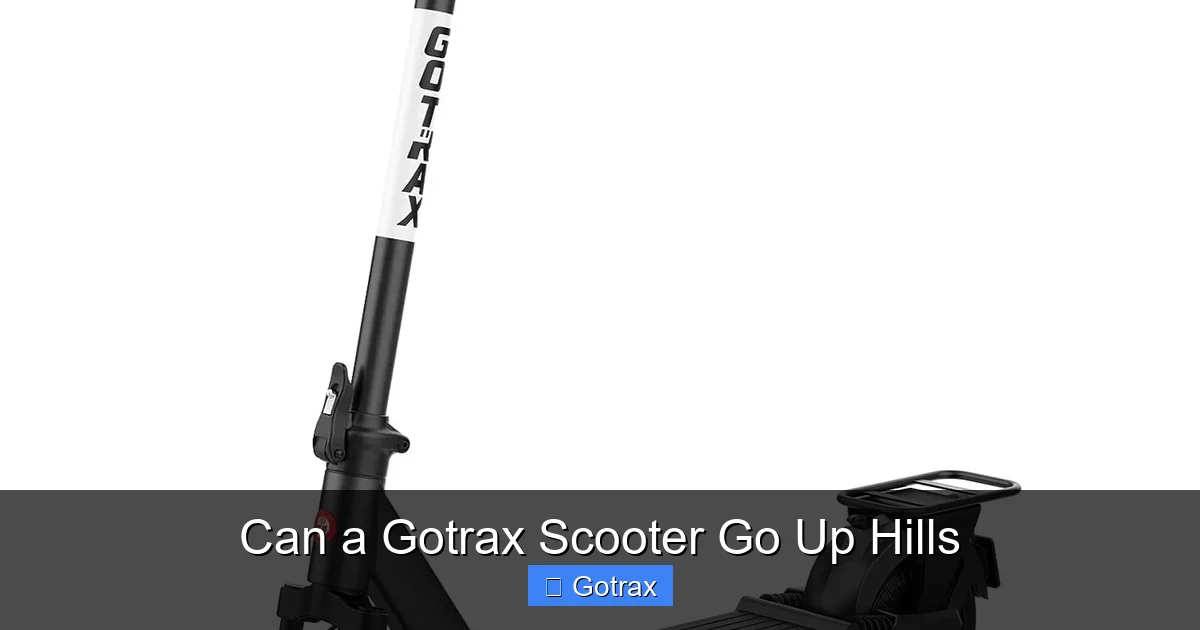
When it comes to hill climbing, motor power is one of the most critical factors. Gotrax scooters come with motors ranging from 250 watts to 500 watts, and this difference significantly affects how well they can tackle inclines.
Motor Wattage Explained
Motor wattage refers to the power output of the scooter’s electric motor. A higher wattage means more torque and better acceleration, which translates to improved hill-climbing ability. For example, a 250W motor—found in models like the Gotrax GXL V2 or XR Elite—is great for flat surfaces and gentle slopes. But when faced with a steep hill, it may struggle, especially if the rider is on the heavier side or the battery is low.
On the other hand, scooters with 350W or 500W motors—such as the Gotrax G4 or G Max Ultra—are built for more demanding rides. These models deliver stronger performance on inclines and can maintain higher speeds even when going uphill. The G4, for instance, is often praised for its smooth acceleration and ability to handle 10–12% grades without breaking a sweat.
Real-World Hill Climbing Examples
Let’s put this into perspective. Imagine you’re riding a Gotrax GXL V2 (250W) up a 7% incline—a common slope in many suburban neighborhoods. If you weigh around 150 pounds and your battery is fully charged, you’ll likely make it up the hill, though your speed may drop from 15 mph to around 8–10 mph. Now, if you weigh 200 pounds or the hill is closer to 12%, that same scooter might slow to a crawl or even stall.
Compare that to the Gotrax G4 (350W), which can handle a 10% incline with a 180-pound rider and still maintain a respectable 10–12 mph. The difference is noticeable—and for daily commuters in hilly areas, it can mean the difference between arriving on time and walking the last stretch.
Why Motor Power Isn’t the Only Factor
While motor wattage is important, it’s not the only thing that determines hill performance. Battery health, tire type, rider weight, and even riding technique all play a role. A 350W motor with a nearly dead battery won’t outperform a 250W motor with a full charge. Similarly, a lightweight rider on a 250W scooter might climb hills more easily than a heavier rider on a 350W model.
So, while motor power gives you a good starting point, it’s essential to consider the full picture when evaluating a Gotrax scooter’s hill-climbing ability.
Gotrax Scooter Models Compared: Which Ones Handle Hills Best?
Visual guide about Can a Gotrax Scooter Go Up Hills
Image source: cdn.shopify.com
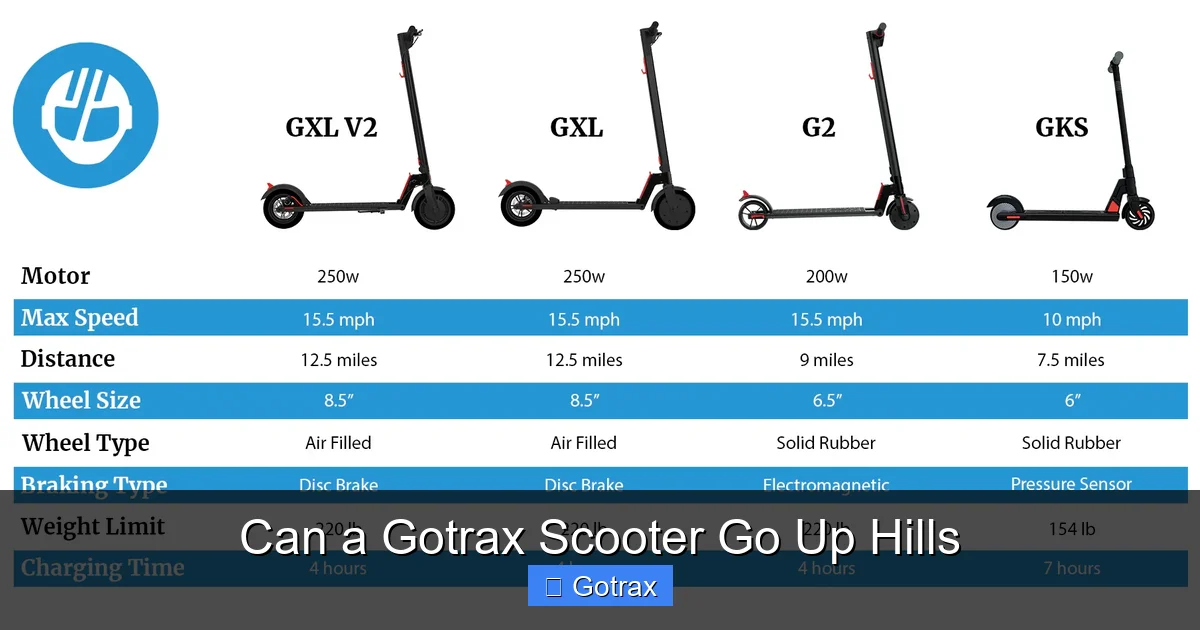
Not all Gotrax scooters are created equal—especially when it comes to hills. Let’s break down some of the most popular models and see how they stack up.
Gotrax GXL V2 (250W)
The GXL V2 is one of Gotrax’s best-selling models, known for its affordability and solid performance on flat terrain. With a 250W motor and a top speed of 15.5 mph, it’s great for city commuting. However, when it comes to hills, it has limitations.
This scooter can handle gentle inclines—think 5–7% grades—especially with lighter riders. But anything steeper than that, and you’ll notice a significant drop in speed. Some users report that the GXL V2 struggles on hills over 10%, particularly if the battery is below 50%. It’s a reliable scooter for mostly flat areas, but not the best choice if you live in a hilly city.
Gotrax XR Elite (250W)
Similar to the GXL V2, the XR Elite also features a 250W motor and is designed for urban commuting. It has a slightly longer range (up to 18 miles) and improved suspension, which helps with comfort on bumpy roads. However, its hill-climbing ability is comparable to the GXL V2.
The XR Elite can manage mild hills, but it’s not built for steep inclines. If your route includes frequent or steep hills, you might find yourself pedaling or walking parts of the way. That said, for riders under 160 pounds and with moderate hills, it’s still a viable option.
Gotrax G4 (350W)
Now we’re getting into more capable territory. The Gotrax G4 features a 350W motor, a 36V battery, and a top speed of 18 mph. This model is a significant step up in performance, especially on hills.
The G4 can comfortably handle 10–12% inclines, even with riders up to 220 pounds. Many users report smooth, consistent power delivery when climbing, thanks to the stronger motor and better torque. It also has pneumatic (air-filled) tires, which provide better grip and shock absorption on uneven surfaces—important when navigating hilly terrain.
If you live in a moderately hilly area and want a scooter that won’t slow you down, the G4 is one of the best Gotrax options available.
Gotrax G Max Ultra (500W)
For those who need serious hill-climbing power, the G Max Ultra is Gotrax’s top-tier model. With a 500W motor and a 48V battery, it’s built for performance. This scooter can tackle 15% inclines with ease and still maintain speeds of 12–14 mph uphill.
The G Max Ultra also features full suspension, dual braking systems, and large 10-inch pneumatic tires—making it ideal for rough or hilly terrain. It’s heavier than other models (around 45 pounds), but the extra power and stability make it worth it for serious riders.
If you frequently ride in hilly areas or carry heavy loads, the G Max Ultra is the Gotrax scooter to beat.
Gotrax Off-Road Series (GORIDE, G4 Off-Road)
Gotrax also offers off-road versions of some models, like the G4 Off-Road and GORIDE. These scooters come with knobby tires, enhanced suspension, and reinforced frames—designed for dirt paths, gravel, and steep inclines.
The GORIDE, for example, has a 500W motor and can handle 15–20% grades, making it one of the most capable Gotrax scooters for hills. It’s perfect for riders who want to explore trails or navigate rugged neighborhoods.
Factors That Affect Hill Climbing on a Gotrax Scooter
While motor power and model choice are important, several other factors influence how well your Gotrax scooter will perform on hills.
Rider Weight
Heavier riders put more strain on the motor and battery, especially on inclines. Most Gotrax scooters have a weight limit of 220–260 pounds, and exceeding this can reduce performance and even damage the scooter over time.
For example, a 150-pound rider on a Gotrax G4 will climb hills much more easily than a 220-pound rider. If you’re near the weight limit, consider upgrading to a more powerful model like the G Max Ultra.
Battery Level and Health
A fully charged battery delivers maximum power to the motor. As the battery depletes, the motor’s output decreases—making hill climbs harder. Riding uphill with a low battery is like trying to sprint on an empty stomach: it’s possible, but not efficient.
To maintain performance, always start your ride with a full charge. Also, avoid letting the battery drop below 20% regularly, as this can shorten its lifespan.
Tire Type and Pressure
Gotrax scooters come with either solid rubber tires or pneumatic (air-filled) tires. Pneumatic tires offer better traction, shock absorption, and grip—especially on wet or uneven surfaces.
If your scooter has solid tires, you may notice more slipping or bouncing on hills. Consider upgrading to a model with air-filled tires if hill performance is a priority.
Also, keep pneumatic tires properly inflated. Underinflated tires increase rolling resistance, making hills feel steeper and harder to climb.
Terrain and Surface Conditions
The surface you’re riding on matters. A smooth, dry asphalt hill is much easier to climb than a gravel, wet, or icy slope. Loose gravel can cause wheels to slip, while wet surfaces reduce traction and increase braking distance.
If you frequently ride in rainy or snowy conditions, choose a scooter with good tread and consider adding fenders to keep water off your feet.
Riding Technique
How you ride also affects hill performance. Here are a few tips:
– Lean forward: Shift your weight slightly forward to keep the front wheel grounded and improve balance.
– Maintain speed: Approach the hill at a steady speed. Slowing down too much at the base can make it harder to climb.
– Avoid sudden stops: If you stop midway up a hill, it’s harder to restart. Try to maintain momentum.
– Use both brakes gently: On steep descents, use both front and rear brakes to control speed without skidding.
Tips for Conquering Hills on a Gotrax Scooter
Even if your Gotrax scooter isn’t the most powerful model, you can still improve your hill-climbing experience with a few smart strategies.
Choose the Right Model for Your Needs
If hills are a regular part of your route, invest in a scooter with a stronger motor—like the G4 or G Max Ultra. It’s better to spend a little more upfront than to struggle with a underpowered model.
Keep Your Scooter Well-Maintained
Regular maintenance ensures your scooter performs at its best. Check tire pressure weekly, clean the deck and wheels, and inspect the brakes. A well-maintained scooter climbs hills more efficiently.
Plan Your Route
Use apps like Google Maps or Komoot to find routes with fewer steep hills. Sometimes, a slightly longer path with gentler slopes is faster and less tiring than a short, steep climb.
Carry a Portable Charger
If you’re going on a long ride with multiple hills, consider carrying a portable battery pack. Some Gotrax models support external charging, which can give you an extra boost when needed.
Practice on Smaller Hills First
If you’re new to riding on inclines, start with gentle slopes and work your way up. This helps you get comfortable with balance, braking, and throttle control.
Real User Experiences: What Gotrax Riders Say About Hills
To get a real sense of how Gotrax scooters perform on hills, it’s helpful to hear from actual users.
One rider from Portland, Oregon—a city known for its hills—shared that their Gotrax G4 handles most inclines “without breaking a sweat.” They noted that while the scooter slows down on steeper grades, it never stalled or required walking.
Another user in Denver mentioned that their GXL V2 struggled on 10% hills, especially in colder weather. They eventually upgraded to the G Max Ultra and noticed a “night-and-day difference” in performance.
A third rider, who uses a Gotrax GORIDE for weekend trail rides, said the scooter “climbs like a goat” on dirt paths and rocky inclines. They credited the 500W motor and knobby tires for the excellent traction.
These experiences highlight an important point: while no Gotrax scooter is perfect for every hill, there’s a model out there that can meet your needs—if you choose wisely.
Conclusion: Can a Gotrax Scooter Go Up Hills?
So, can a Gotrax scooter go up hills? The answer is a resounding yes—but with caveats. Most Gotrax electric scooters can handle mild to moderate inclines, especially if you choose a model with a stronger motor and follow best practices for riding and maintenance.
For flat city commutes, the GXL V2 or XR Elite are excellent, affordable options. But if hills are a regular part of your ride, consider upgrading to the G4, G Max Ultra, or an off-road model like the GORIDE. These scooters offer the power, traction, and stability needed to conquer steeper grades with confidence.
Remember, hill performance isn’t just about the scooter—it’s also about rider weight, battery health, terrain, and technique. By understanding these factors and choosing the right model, you can enjoy smooth, reliable rides—no matter the slope.
Whether you’re cruising through downtown or exploring hilly neighborhoods, a Gotrax scooter can be a fun, eco-friendly way to get around. Just make sure you pick the one that matches your terrain—and don’t be afraid to lean into the climb.
Frequently Asked Questions
Can a Gotrax scooter go up steep hills?
Most Gotrax scooters can handle mild to moderate hills (5–10% grades), but steep hills over 15% may be challenging, especially for lower-wattage models. Higher-powered scooters like the G Max Ultra perform much better on steep inclines.
What Gotrax model is best for hills?
The Gotrax G4 (350W) and G Max Ultra (500W) are the best models for hill climbing. They offer stronger motors, better torque, and improved traction, making them ideal for hilly terrain.
Does rider weight affect hill performance?
Yes, heavier riders put more strain on the motor and battery, reducing hill-climbing ability. Most Gotrax scooters support up to 220–260 pounds, but performance may decline near the limit.
Can I improve my Gotrax scooter’s hill performance?
Yes! Keep the battery fully charged, maintain proper tire pressure, choose routes with gentler slopes, and use proper riding technique like leaning forward and maintaining speed.
Do Gotrax scooters have different tire types?
Yes. Some models have solid rubber tires, while others feature pneumatic (air-filled) tires. Pneumatic tires offer better grip and comfort on hills and uneven surfaces.
Is it safe to ride a Gotrax scooter downhill?
Yes, but always use both brakes gently and lean back slightly to maintain control. Avoid sudden stops, and wear a helmet for safety, especially on steep descents.