

If your Gotrax scooter won’t move, it’s often due to a dead battery, loose connections, or safety features like the kickstand sensor. Most issues are fixable at home with basic troubleshooting. This guide walks you through step-by-step solutions to revive your scooter and get back on the road safely.
Key Takeaways
- Battery issues are the #1 cause: A drained, old, or improperly charged battery is the most common reason a Gotrax scooter won’t move. Always check charge level first.
- Safety sensors can prevent movement: The kickstand, brake, and throttle sensors must all be engaged correctly for the scooter to operate.
- Loose or damaged wiring matters: Vibrations from riding can loosen internal connections, especially in the throttle or motor harness.
- Firmware glitches happen: Sometimes a simple reboot or firmware reset resolves unresponsive behavior.
- Tire pressure and mechanical resistance count: Underinflated tires or seized wheels can make it seem like the motor isn’t working.
- Age and wear affect performance: Older models may have degraded motors or batteries that need replacement.
- Always consult the manual: Gotrax provides model-specific troubleshooting—don’t skip this resource.
📑 Table of Contents
- Why Won’t My Gotrax Scooter Move? A Complete Troubleshooting Guide
- 1. Battery Problems: The #1 Culprit
- 2. Safety Sensors and Interlocks
- 3. Wiring and Connection Issues
- 4. Firmware and Software Glitches
- 5. Mechanical and Physical Obstructions
- 6. When to Seek Professional Help
- Preventing Future Issues
- Conclusion
Why Won’t My Gotrax Scooter Move? A Complete Troubleshooting Guide
You hop on your Gotrax scooter, twist the throttle, and… nothing. No hum, no movement—just silence. It’s frustrating, especially when you’re ready to zip to work, school, or just enjoy a quick ride around the neighborhood. Before you panic or assume the worst, know this: most Gotrax scooters that won’t move have simple, fixable causes. From battery hiccups to hidden safety switches, the solution is often easier than you think.
Gotrax scooters are known for their reliability, affordability, and user-friendly design. But like any electric vehicle, they rely on a delicate balance of electrical components, sensors, and mechanical parts. When one piece fails or gets out of sync, the whole system can shut down. The good news? You don’t need to be an engineer to diagnose and fix most issues. With a little patience and the right approach, you can often get your scooter moving again in under 30 minutes.
In this guide, we’ll walk you through the most common reasons your Gotrax scooter won’t move—and how to fix them step by step. Whether you’re dealing with a brand-new model or an older scooter that’s seen better days, these troubleshooting tips apply across the Gotrax lineup, including popular models like the GXL, G2, G3, and G4. Let’s get your ride back on track.
1. Battery Problems: The #1 Culprit
Visual guide about Why Won T My Gotrax Scooter Move
Image source: scooterinsights.com
If your Gotrax scooter won’t move, the battery should be your first stop. It’s the heart of your scooter—without power, nothing else matters. Even if the display lights up or the scooter seems “on,” a weak or improperly charged battery can prevent the motor from engaging.
Check the Charge Level
Start by looking at the battery indicator on your scooter’s display. If it shows one bar or is completely empty, your scooter likely doesn’t have enough juice to move. Plug it into the charger and let it charge for at least 4–6 hours. Gotrax recommends a full charge before first use and after every ride. Don’t rely on quick top-offs—lithium-ion batteries need time to reach full capacity.
Use the Right Charger
Always use the original Gotrax charger that came with your scooter. Third-party chargers may not deliver the correct voltage or current, leading to undercharging or even battery damage. If you’ve lost your charger, buy a replacement directly from Gotrax or an authorized retailer. Using the wrong charger is a common mistake that can make it seem like the battery is dead when it’s actually just not charging properly.
Test the Battery Voltage
If your scooter still won’t move after charging, you can test the battery voltage with a multimeter. A fully charged Gotrax battery should read around 36V (for 36V models) or 48V (for 48V models). If it’s significantly lower—say, below 30V for a 36V battery—the battery may be degraded or faulty. Over time, lithium-ion batteries lose capacity, especially if they’ve been deeply discharged repeatedly or stored in extreme temperatures.
Battery Age and Replacement
Gotrax batteries typically last 2–3 years with regular use. If your scooter is older and the battery no longer holds a charge, it may be time for a replacement. Signs of a dying battery include short ride times, slow acceleration, and the scooter cutting out mid-ride. Replacing the battery is a bit more involved—you’ll need to open the deck and disconnect the old unit—but Gotrax provides guides and replacement parts. Don’t ignore this step: a new battery can breathe life back into an otherwise functional scooter.
2. Safety Sensors and Interlocks
Gotrax scooters are packed with safety features designed to prevent accidents. But sometimes, these very features can stop your scooter from moving—even when everything else is working fine. The most common culprits are the kickstand sensor, brake sensor, and throttle interlock.
Kickstand Sensor
The kickstand sensor is a small switch that detects whether the kickstand is up or down. If the sensor thinks the kickstand is down, it won’t allow the motor to engage—this prevents you from accidentally riding with the stand deployed. If your scooter won’t move, check that the kickstand is fully retracted. Sometimes dirt, debris, or a bent sensor can cause a false reading. Try gently wiggling the kickstand or cleaning around the sensor area. On some models, you can test the sensor by pressing it manually with a screwdriver (while the scooter is off) to see if the display responds.
Brake Sensor
Most Gotrax scooters have electronic brake sensors that cut power to the motor when the brake lever is pressed. This is a safety feature, but if the sensor is stuck or misaligned, it can make the scooter think the brake is always on. Try squeezing and releasing the brake lever a few times to see if it “unsticks.” If the lever feels loose or unresponsive, the sensor may need adjustment or replacement. You can also check for loose wires near the brake lever—vibrations from riding can cause connections to come loose over time.
Throttle Interlock
The throttle interlock ensures that the motor only engages when you’re ready to ride. On many Gotrax models, you must press the brake lever before twisting the throttle. If you skip this step, the scooter won’t move. This is a common mistake for new riders. Always remember: brake first, then throttle. If your scooter still won’t respond, the throttle itself might be faulty. Test it by gently twisting it while listening for a click or watching the display for a response. No reaction? The throttle may need to be replaced.
3. Wiring and Connection Issues
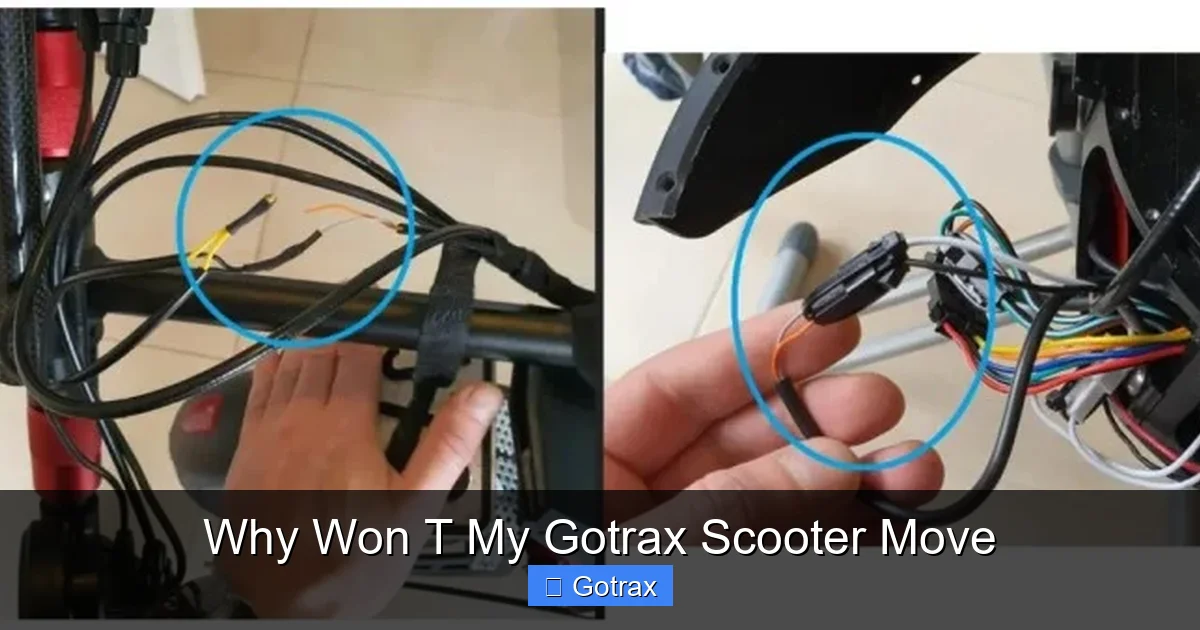
Electric scooters are full of wires, and over time, vibrations, weather, and rough handling can cause connections to loosen or corrode. If your Gotrax scooter won’t move, a loose wire might be the silent culprit.
Check the Throttle Connection
The throttle is one of the most frequently used components, and its wiring is prone to wear. Open the handlebar cover (usually held by a few screws) and inspect the throttle connector. Make sure it’s securely plugged in and that the wires aren’t frayed or pinched. If the connector looks loose, unplug it and reseat it firmly. Sometimes, simply reconnecting it solves the problem.
Inspect the Motor Harness
The motor harness runs from the deck to the rear wheel and connects the battery to the motor. This wire bundle is exposed to the elements and can get damaged by road debris or repeated flexing. Look for cuts, kinks, or exposed copper. If you find damage, the harness may need to be replaced. Even if it looks fine, check that the connector at the motor is tight. A loose connection here can prevent power from reaching the motor.
Battery and Controller Connections
Inside the deck, the battery connects to the controller—the brain of the scooter. If these connections are loose, the scooter won’t move, even with a full charge. To check, you’ll need to remove the deck panel (usually with a Phillips screwdriver). Once inside, look for the main power wires and ensure they’re tightly connected. Be careful not to touch any components while the scooter is plugged in. If you’re not comfortable doing this, take it to a repair shop.
Corrosion and Moisture
If your scooter has been exposed to rain or humidity, moisture can cause corrosion on connectors and circuit boards. This can interrupt the flow of electricity. Look for green or white residue on metal parts—this is a sign of corrosion. Clean it gently with a cotton swab and isopropyl alcohol. Let everything dry completely before reassembling. To prevent future issues, avoid riding in heavy rain and store your scooter in a dry place.
4. Firmware and Software Glitches
Yes, your Gotrax scooter has software—and like any electronic device, it can experience glitches. Sometimes, a simple reboot or firmware reset can fix issues that seem mechanical.
Power Cycle the Scooter
The first step is to turn the scooter off, wait 10–15 seconds, and turn it back on. This resets the controller and can clear temporary errors. If your scooter has a removable battery, try removing it for 30 seconds before reinserting and powering on. This forces a full system reset.
Check for Error Codes
Some Gotrax models display error codes on the LCD screen when something’s wrong. For example, “E1” might indicate a throttle issue, while “E2” could point to a motor problem. Refer to your user manual for a list of error codes and their meanings. If you see a code, note it down and search online or contact Gotrax support for guidance.
Update Firmware (If Available)
Gotrax occasionally releases firmware updates to improve performance and fix bugs. While most models don’t support user updates, some newer ones (like the G4) may allow firmware updates via a mobile app or USB connection. Check the Gotrax website or app for updates. If an update is available, follow the instructions carefully—interrupting the process can brick your scooter.
Factory Reset
If your scooter is acting erratically—shutting off randomly, not responding to the throttle, or displaying odd behavior—a factory reset might help. This restores the controller to its original settings. The process varies by model, but it usually involves holding down specific buttons while powering on. Consult your manual for the exact steps.
5. Mechanical and Physical Obstructions
Sometimes, the problem isn’t electrical—it’s mechanical. If your Gotrax scooter won’t move, something might be physically blocking the wheels or motor.
Check Tire Pressure
Underinflated tires create extra resistance, making it harder for the motor to turn the wheels. Check the tire pressure with a gauge—most Gotrax scooters recommend 40–50 PSI. If the tires are flat or low, inflate them to the recommended level. This can make a huge difference in performance, especially on hills or rough surfaces.
Inspect the Wheels
Spin each wheel by hand. Does it turn freely? If it feels stiff or grinds, there might be debris stuck in the bearings or a mechanical issue. Remove the wheel (if you’re comfortable doing so) and check for dirt, rocks, or damaged bearings. Clean and lubricate the axle if needed. For hub motors, listen for unusual noises—grinding or clicking could indicate internal damage.
Brake Drag
If the brake pads are too tight, they can rub against the wheel, creating drag. This makes it feel like the motor isn’t working, even if it is. Check the brake calipers and adjust them so there’s a small gap between the pad and the rotor. Most Gotrax scooters have adjustable brake levers—loosen the cable slightly if the brake feels too tight.
Chain or Belt Issues (If Applicable)
Some Gotrax models use a belt or chain drive instead of a direct hub motor. If your scooter has one, check that the belt isn’t loose, worn, or broken. A slipping belt can make the scooter feel underpowered or unresponsive. Tighten or replace it as needed.
6. When to Seek Professional Help
Despite your best efforts, some issues require professional attention. If you’ve tried all the steps above and your Gotrax scooter still won’t move, it’s time to call in the experts.
Motor Failure
If the motor is completely dead—no sound, no movement, even with a full battery—it may have failed. Motors can burn out due to overheating, water damage, or age. Replacing a motor is complex and usually requires specialized tools. Unless you’re experienced with electronics, it’s best to let a technician handle this.
Controller Malfunction
The controller manages power delivery to the motor. If it’s faulty, the scooter won’t move, even if everything else is working. Controllers are expensive and difficult to test without proper equipment. If you suspect a controller issue, contact Gotrax support or a certified repair center.
Warranty and Support
Gotrax offers a limited warranty on their scooters, typically covering defects for 90 days to one year, depending on the model. If your scooter is still under warranty and won’t move due to a manufacturing defect, you may be eligible for a repair or replacement. Contact Gotrax customer service with your model number and purchase date. Keep your receipt—it’s required for warranty claims.
Authorized Repair Centers
Gotrax has a network of authorized repair centers across the U.S. These shops have trained technicians who know Gotrax scooters inside and out. They can diagnose and fix issues quickly, often while you wait. Use the Gotrax website to find a location near you.
Preventing Future Issues
Once your scooter is moving again, take steps to avoid the same problem in the future. Regular maintenance goes a long way.
– Charge your battery after every ride—don’t let it sit dead.
– Store your scooter in a dry, temperature-controlled area.
– Check tire pressure monthly.
– Inspect wires and connections every few months.
– Avoid riding in heavy rain or extreme temperatures.
– Follow the user manual for care and maintenance.
A little attention now can save you hours of frustration later.
Conclusion
If your Gotrax scooter won’t move, don’t panic. Start with the basics: check the battery, inspect the safety sensors, and look for loose wires. Most issues are simple fixes that you can handle at home with basic tools. From dead batteries to stuck brake sensors, the solutions are often quicker and easier than you think.
Remember, Gotrax scooters are built to be user-friendly, and the company provides solid support and resources. Whether you’re troubleshooting a new scooter or reviving an older one, the key is patience and methodical checking. With the steps in this guide, you’ll be back on the road in no time.
And if all else fails? Reach out to Gotrax support or visit an authorized repair center. Your scooter deserves to move—and so do you.
Frequently Asked Questions
Why won’t my Gotrax scooter move even though the battery is charged?
Even with a full battery, your scooter might not move due to safety sensors like the kickstand or brake sensor being engaged. Check that the kickstand is up and the brake lever is fully released. Also, ensure you’re pressing the brake before twisting the throttle, as required by most models.
Can a loose wire cause my Gotrax scooter to stop working?
Yes, loose or damaged wires—especially in the throttle, motor harness, or battery connections—can prevent your scooter from moving. Vibrations from riding can loosen connections over time. Inspect wiring inside the handlebar and deck, and reseat any loose connectors.
How do I reset my Gotrax scooter if it’s not responding?
Try a power cycle: turn the scooter off, wait 15 seconds, and turn it back on. For a deeper reset, remove the battery for 30 seconds before reinserting it. Some models also support a factory reset—check your user manual for the correct button combination.
My Gotrax scooter makes a noise but doesn’t move—what’s wrong?
This could indicate a mechanical issue like brake drag, underinflated tires, or a seized wheel. Check tire pressure and spin the wheels by hand. If they don’t turn freely, inspect for debris or brake pad interference.
Is it safe to open the deck of my Gotrax scooter to check wires?
Yes, but only if you’re comfortable working with electronics. Always disconnect the battery before opening the deck to avoid electric shock. If you’re unsure, take it to a professional. Never work on the scooter while it’s plugged in.
How long do Gotrax scooter batteries last?
Gotrax batteries typically last 2–3 years with regular use, depending on charging habits and storage conditions. Avoid deep discharges and extreme temperatures to extend battery life. Replace the battery if ride times become significantly shorter.