
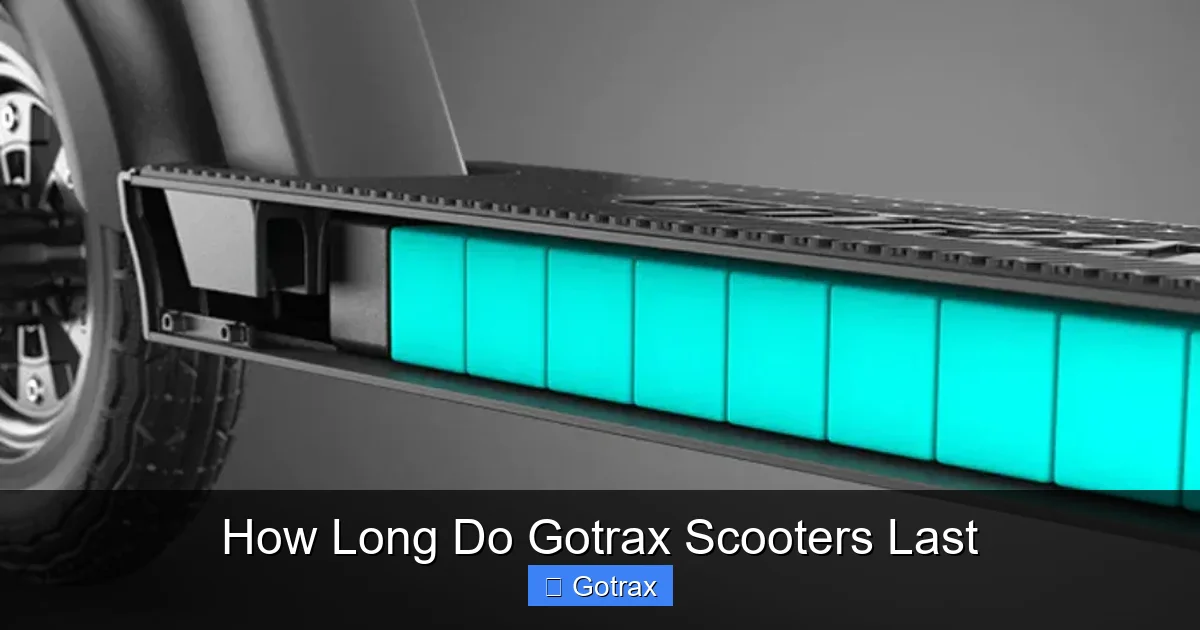
Gotrax scooters typically last 2 to 4 years with regular use, depending on model, riding habits, and maintenance. With proper care—especially battery management and tire upkeep—you can extend their lifespan significantly and enjoy reliable, eco-friendly commuting for years.
Key Takeaways
- Battery life is the biggest factor: Most Gotrax scooters use lithium-ion batteries that last 300–500 charge cycles, translating to 1–3 years of daily use.
- Build quality varies by model: Higher-end models like the GXL V2 or XR offer more durable frames and components than entry-level scooters like the GKS.
- Regular maintenance extends lifespan: Cleaning, tire checks, brake adjustments, and firmware updates help prevent premature wear.
- Riding conditions matter: Frequent use on rough terrain, hills, or in wet weather can shorten a scooter’s life.
- Proper storage is crucial: Storing your Gotrax in a dry, temperature-controlled environment protects the battery and electronics.
- Warranty and support: Gotrax offers a 1-year limited warranty, which can help with early defects but won’t cover long-term wear.
- Upgrades and replacements: Swapping out worn parts like tires, brakes, or even the battery can breathe new life into an older scooter.
📑 Table of Contents
- How Long Do Gotrax Scooters Last? A Complete Guide
- Understanding Gotrax Scooter Lifespan: What Determines Longevity?
- Battery Lifespan: The #1 Factor in Scooter Longevity
- Build Quality and Durability Across Gotrax Models
- Maintenance Tips to Extend Your Gotrax Scooter’s Life
- Environmental and Usage Factors That Affect Lifespan
- Gotrax Warranty and Customer Support
- Conclusion: Maximizing the Life of Your Gotrax Scooter
How Long Do Gotrax Scooters Last? A Complete Guide
If you’re thinking about buying a Gotrax electric scooter—or you already own one—you’ve probably asked yourself: *How long do Gotrax scooters last?* It’s a smart question. After all, these sleek, eco-friendly rides aren’t just fun; they’re an investment in your daily commute, weekend adventures, or last-mile transportation solution.
Gotrax has become one of the most popular names in the affordable electric scooter market. Known for their reliability, stylish designs, and user-friendly features, Gotrax scooters appeal to students, urban commuters, and casual riders alike. But like any electric vehicle, they don’t last forever. The real answer to “how long do Gotrax scooters last” depends on several factors—some within your control, others tied to the scooter’s design and usage.
In this guide, we’ll break down everything you need to know about the lifespan of Gotrax scooters. From battery longevity and build quality to maintenance tips and real-world examples, we’ll help you understand what to expect and how to get the most out of your ride. Whether you’re riding a Gotrax GKS for short campus trips or a Gotrax XR for daily city commutes, this article will give you the insights to maximize your scooter’s life.
Understanding Gotrax Scooter Lifespan: What Determines Longevity?
Visual guide about How Long Do Gotrax Scooters Last
Image source: quingoscooters.com
When it comes to electric scooters, lifespan isn’t just about how many miles you can ride before it breaks down. It’s a combination of mechanical durability, battery health, usage patterns, and care. Gotrax scooters, like most e-scooters, are built to last—but their actual lifespan can vary widely.
On average, a well-maintained Gotrax scooter will last between **2 to 4 years** with regular use. Some riders report getting 5+ years out of their scooters with meticulous care, while others may see performance decline after just 18 months. So why the difference?
Let’s look at the key factors that influence how long your Gotrax scooter will last.
Battery Life: The Heart of Your Scooter
The battery is the most critical component affecting your scooter’s lifespan. Gotrax scooters use lithium-ion (Li-ion) batteries, which are lightweight, efficient, and rechargeable. However, they degrade over time—even if you don’t use them.
Most Gotrax models come with batteries rated for **300 to 500 full charge cycles**. A charge cycle means using 100% of the battery’s capacity, whether in one go or over multiple rides. For example, if you use 50% of the battery one day and recharge it, then use another 50% the next day, that counts as one full cycle.
If you ride daily and fully drain the battery each time, you’ll hit 300–500 cycles in about **1 to 2.5 years**. After that, the battery’s capacity drops—meaning shorter rides, slower speeds, and more frequent charging. Eventually, it may no longer hold a charge at all.
But here’s the good news: you can slow this degradation. Avoid fully draining the battery regularly. Instead, recharge when it hits 20–30%. Also, don’t leave it plugged in overnight after it’s fully charged. These small habits can add months—or even years—to your battery’s life.
Build Quality and Model Differences
Not all Gotrax scooters are created equal. The brand offers a range of models, from budget-friendly options like the GKS to more robust ones like the GXL V2 and XR.
Entry-level models like the GKS are great for light use—short rides on smooth pavement, occasional commuting. But they’re built with lighter materials and simpler components. The frame may flex more, the tires are smaller and less durable, and the motor is less powerful. These scooters are more prone to wear and tear, especially if used daily or on rough terrain.
In contrast, mid- to high-tier models like the GXL V2 and XR feature reinforced aluminum frames, larger pneumatic tires, better suspension, and more powerful motors. These are designed for heavier use and can handle hills, bumps, and longer distances. As a result, they tend to last longer—often 3 to 4 years or more with proper care.
So, if you’re asking “how long do Gotrax scooters last,” the answer starts with: *Which model do you have?*
Usage Patterns and Riding Habits
How you ride your scooter plays a huge role in its lifespan. A Gotrax scooter used for short, gentle rides on flat sidewalks will last much longer than one used for daily uphill commutes or off-road adventures.
Frequent acceleration, hard braking, and riding at top speed put extra strain on the motor, battery, and brakes. Riding in rain, snow, or on gravel can damage the electronics and wear down tires faster. Even carrying heavy loads beyond the scooter’s weight limit (usually 220–260 lbs) can stress the frame and motor.
For example, a student who rides 2 miles to campus on smooth pavement, avoids rain, and recharges regularly will likely get 3+ years from their Gotrax. Meanwhile, a delivery rider using the same scooter for 10-mile daily trips on hilly streets may see performance drop after 18 months.
The takeaway? Be mindful of how and where you ride. Gentle, consistent use preserves your scooter’s components and extends its life.
Battery Lifespan: The #1 Factor in Scooter Longevity
Visual guide about How Long Do Gotrax Scooters Last
Image source: cdn.shopify.com
If there’s one component that determines how long your Gotrax scooter will last, it’s the battery. Think of it like the engine in a car—without a healthy battery, your scooter simply won’t go.
How Lithium-Ion Batteries Degrade Over Time
Lithium-ion batteries don’t last forever. Even if you never use your scooter, the battery will slowly lose capacity due to chemical aging. Heat, cold, and improper charging accelerate this process.
Every time you charge and discharge the battery, tiny chemical changes occur inside. Over hundreds of cycles, these changes reduce the battery’s ability to hold a charge. You’ll notice this as shorter ride times, slower acceleration, and the need to charge more often.
Most Gotrax batteries are rated for **300 to 500 charge cycles**, but real-world performance depends on care. A well-maintained battery might last 500+ cycles, while a neglected one could degrade in under 200.
Signs Your Battery Is Failing
How do you know when your Gotrax battery is nearing the end of its life? Watch for these signs:
– **Shorter range:** If your scooter used to go 15 miles but now only makes 8, the battery is likely degrading.
– **Slow charging:** Takes much longer to charge than before.
– **Sudden power loss:** The scooter dies mid-ride even though the battery shows charge.
– **Swelling or heat:** A puffy battery or excessive heat during charging is a red flag—stop using it immediately.
If you notice any of these, it’s time to consider a battery replacement. Gotrax sells replacement batteries for most models, and installation is usually straightforward with basic tools.
Tips to Extend Battery Life
You can’t stop battery degradation entirely, but you can slow it down. Here’s how:
– **Avoid full discharges:** Recharge when the battery hits 20–30%, not 0%.
– **Don’t overcharge:** Unplug once fully charged. Use a smart charger if possible.
– **Store properly:** Keep the scooter in a cool, dry place. Avoid extreme heat or cold.
– **Charge regularly:** Even if not in use, charge the battery every 2–3 months to prevent deep discharge.
– **Use the right charger:** Always use the Gotrax-approved charger. Cheap knockoffs can damage the battery.
By following these tips, you can get the most out of your battery and delay the need for a replacement.
Build Quality and Durability Across Gotrax Models
Gotrax offers a wide range of scooters, and their build quality varies significantly. Understanding the differences can help you choose a model that will last—and know what to expect in terms of longevity.
Entry-Level Models: GKS, G2, G4
The Gotrax GKS is one of the most popular entry-level scooters. It’s lightweight, affordable, and great for kids or short commutes. But it’s not built for heavy use.
– **Frame:** Lightweight aluminum, but less rigid.
– **Tires:** Solid rubber, which are puncture-proof but offer poor shock absorption.
– **Motor:** 250W, suitable for flat terrain only.
– **Weight limit:** 185 lbs.
Because of these limitations, the GKS is best for occasional, light use. With daily commuting or rough riding, it may start showing wear after 1.5 to 2 years. The solid tires can crack over time, and the motor may overheat on hills.
The G2 and G4 are slightly upgraded versions with better motors and features, but they still fall into the budget category. Expect 2–3 years of life with moderate use.
Mid-Range Models: GXL V2, XR
The GXL V2 and XR are where Gotrax starts to shine in terms of durability.
– **Frame:** Reinforced aluminum, more resistant to bending.
– **Tires:** Pneumatic (air-filled) tires on the XR, offering better grip and comfort.
– **Motor:** 300W (GXL V2) and 350W (XR), capable of handling hills and longer rides.
– **Suspension:** Basic front suspension on the XR.
– **Weight limit:** 220–260 lbs.
These scooters are built for daily commuting and can handle rougher conditions. With proper care, they often last 3 to 4 years. The pneumatic tires on the XR require occasional inflation and are prone to punctures, but they greatly improve ride quality and reduce strain on the motor.
High-End Models: GMAX, G4 Pro
Gotrax’s premium models, like the GMAX and G4 Pro, are designed for serious riders.
– **Motor:** 500W or higher, with strong hill-climbing ability.
– **Battery:** Larger capacity (up to 15.6Ah), offering longer range.
– **Tires:** Wide pneumatic tires with better tread.
– **Suspension:** Dual suspension systems for smooth rides.
– **Build:** Heavy-duty frames with reinforced joints.
These scooters are built to last. With regular maintenance, they can easily exceed 4 years of use. They’re ideal for riders who need reliability, power, and comfort over long distances.
Real-World Examples of Longevity
Let’s look at a few real-world scenarios:
– **Case 1:** Sarah uses her Gotrax GXL V2 for a 5-mile daily commute in a flat city. She charges it every other day, avoids rain, and does monthly tire checks. After 3.5 years, she notices slightly reduced range but still uses it regularly. She plans to replace the battery soon.
– **Case 2:** Mike uses his GKS for weekend rides and occasional trips to the store. He rarely charges it fully and leaves it in his garage during winter. After 2 years, the battery won’t hold a charge. He replaces it and continues using the scooter for another year.
– **Case 3:** Jenna uses her Gotrax XR for food delivery. She rides 20+ miles daily, often in rain and on hills. After 18 months, the motor starts overheating and the tires are worn. She upgrades to a GMAX and sells the XR for parts.
These examples show that usage and care make a big difference. Even budget models can last years with gentle use, while high-end models can wear out faster under heavy demand.
Maintenance Tips to Extend Your Gotrax Scooter’s Life
You can’t stop time, but you can slow down wear and tear. Regular maintenance is the secret to getting the most out of your Gotrax scooter.
Daily and Weekly Checks
Make these quick checks part of your routine:
– **Tire pressure:** For pneumatic tires, check weekly. Underinflated tires increase rolling resistance and strain the motor.
– **Brake function:** Test brakes before each ride. Squeaky or weak brakes need adjustment.
– **Bolts and screws:** Check for loose parts, especially after rough rides. Tighten as needed.
– **Cleanliness:** Wipe down the deck, handlebars, and wheels to remove dirt and debris.
Monthly Maintenance
Once a month, do a deeper check:
– **Lubricate moving parts:** Apply light lubricant to the folding mechanism, brake cables, and wheel bearings.
– **Inspect tires:** Look for cracks, wear, or embedded debris. Replace if damaged.
– **Check battery connections:** Ensure the battery is seated properly and terminals are clean.
– **Update firmware:** Gotrax occasionally releases firmware updates via their app. These can improve performance and fix bugs.
Seasonal Care
– **Winter storage:** If you live in a cold climate, store your scooter indoors. Cold temperatures damage batteries. Charge to 50–60% before storing.
– **Summer care:** Avoid leaving your scooter in direct sunlight or hot cars. Heat accelerates battery degradation.
– **Deep clean:** Every 3–6 months, give your scooter a thorough wash (avoid high-pressure water near electronics). Dry completely before use.
When to Replace Parts
Even with great care, parts will wear out. Here’s when to consider replacements:
– **Tires:** Replace every 1,000–2,000 miles or when tread is worn.
– **Brakes:** Replace brake pads when they’re thin or no longer grip well.
– **Battery:** Replace when range drops below 50% of original.
– **Motor:** Rarely fails, but if it overheats or makes strange noises, have it checked.
Gotrax sells replacement parts online, and many can be installed at home with basic tools.
Environmental and Usage Factors That Affect Lifespan
Your scooter doesn’t exist in a vacuum. The environment and how you use it play a big role in how long it lasts.
Weather and Climate
Electric scooters aren’t built for extreme conditions.
– **Rain and moisture:** Water can seep into electronics, causing shorts or corrosion. Gotrax scooters are water-resistant (IP54), but not waterproof. Avoid riding in heavy rain or through puddles.
– **Cold weather:** Lithium-ion batteries lose efficiency in cold temps. Range can drop by 20–30% in freezing weather. Store indoors when not in use.
– **Heat:** High temperatures (above 95°F) can damage batteries and motors. Don’t leave your scooter in a hot car.
Terrain and Riding Conditions
Smooth, flat pavement is ideal. But many riders face hills, gravel, or uneven sidewalks.
– **Hills:** Constant uphill riding drains the battery faster and stresses the motor. Use lower speeds and avoid overloading.
– **Gravel and dirt:** These surfaces wear down tires faster and can damage the undercarriage. Stick to paved paths when possible.
– **Curbs and bumps:** Jumping curbs or hitting potholes can bend the frame or damage wheels. Ride carefully.
Weight and Load
Every Gotrax scooter has a weight limit—usually 220 to 260 lbs. Exceeding this limit puts extra stress on the motor, frame, and brakes.
Carrying heavy backpacks or cargo? Consider a scooter with a higher weight capacity, like the GMAX. Overloading can lead to premature failure, even if the scooter seems fine at first.
Gotrax Warranty and Customer Support
Gotrax offers a **1-year limited warranty** on all scooters. This covers defects in materials and workmanship, but not normal wear and tear.
What’s covered:
– Motor failure
– Battery defects
– Frame cracks
– Electrical issues
What’s not covered:
– Tire wear
– Brake pad replacement
– Battery degradation from use
– Damage from accidents or misuse
If your scooter fails within the first year due to a manufacturing defect, Gotrax will repair or replace it. But after that, you’re on your own—unless you buy an extended warranty.
Customer support is generally responsive, with email and phone support available. Many users report quick replacements for defective parts.
Conclusion: Maximizing the Life of Your Gotrax Scooter
So, how long do Gotrax scooters last? The answer isn’t one-size-fits-all. With proper care, a Gotrax scooter can last **2 to 4 years**—and sometimes longer. The key is understanding what affects longevity and taking proactive steps to protect your investment.
Start with the battery: avoid full discharges, don’t overcharge, and store in a cool, dry place. Choose a model that matches your usage—budget models for light riders, premium ones for daily commuters. Maintain your scooter regularly: check tires, brakes, and bolts, and clean it often. And be mindful of where and how you ride—avoid extreme weather, rough terrain, and overloading.
Gotrax scooters are built to be affordable and reliable, but they’re not indestructible. Treat them well, and they’ll take you far—literally and figuratively. Whether you’re zipping across campus or cruising downtown, a well-cared-for Gotrax can be a trusted companion for years to come.
Frequently Asked Questions
How long does the battery last on a Gotrax scooter?
The battery typically lasts 300–500 charge cycles, which translates to 1–3 years of daily use. With proper care, you can extend this lifespan.
Can I replace the battery in my Gotrax scooter?
Yes, Gotrax sells replacement batteries for most models. Installation is usually simple and can be done at home with basic tools.
Do Gotrax scooters work in the rain?
Gotrax scooters are water-resistant (IP54), but not waterproof. Light rain is okay, but avoid heavy downpours or puddles to prevent damage.
How often should I charge my Gotrax scooter?
Recharge when the battery drops to 20–30%. Avoid letting it fully drain regularly, and don’t leave it plugged in overnight.
What’s the best way to store my Gotrax scooter?
Store in a cool, dry place away from extreme temperatures. Charge to 50–60% if storing for long periods, like over winter.
How can I tell if my Gotrax scooter is wearing out?
Signs include shorter range, slow charging, sudden power loss, or unusual noises. Regular maintenance can help catch issues early.