
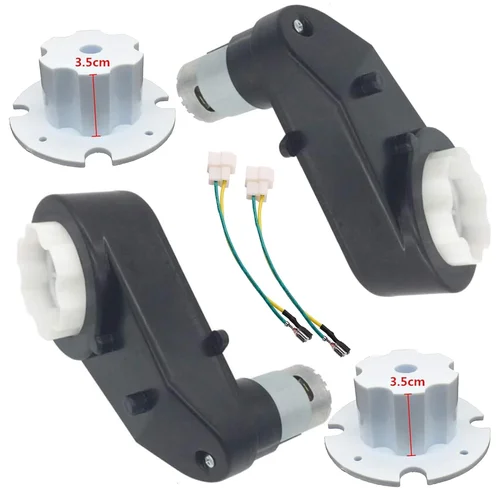
If you’re reading this, chances are you’ve got a project that relies on a 12V 550 motor gearbox—and it’s either broken, worn out, or just not performing like it used to. Whether you’re restoring a vintage RC car, upgrading a robotics kit, or keeping your electric scooter running smoothly, finding the right replacement isn’t as simple as clicking “buy now” on the first listing you see. The market is flooded with options, many of which look identical but vary wildly in quality, compatibility, and long-term reliability.
This guide exists to cut through the noise. We’ll walk you through every critical factor you need to consider before purchasing a replacement 12V 550 motor gearbox, from verifying physical compatibility to understanding torque ratings and gear ratios. You’ll learn how to avoid common pitfalls, decode technical specs like a pro, and ultimately choose a unit that delivers consistent performance without breaking the bank. By the end, you won’t just know what to buy—you’ll understand why it matters.
The 12V 550 motor gearbox is one of the most widely used DC motor configurations in hobbyist electronics, small-scale automation, and DIY engineering projects. Its popularity stems from its balance of power, size, and affordability. However, because it’s so common, manufacturers have flooded the market with clones, knockoffs, and rebranded units—some excellent, others barely functional. Without careful evaluation, you risk wasting money on a part that fails within weeks or worse, damages other components in your system. This guide arms you with the knowledge to make a confident, informed decision.

What to Look for When Buying Buying Guide
1. Physical Compatibility & Mounting Dimensions
Before anything else, you must confirm that the replacement gearbox will physically fit into your existing setup. The “550” designation refers to the motor can size—approximately 36mm in diameter and 50mm in length—but gearboxes vary significantly in shaft height, mounting hole spacing, and overall length. Even a few millimeters off can render a unit unusable.
Start by measuring your current motor’s mounting points: note the distance between screw holes (typically M3 or #4-40), the position of the output shaft relative to the base, and the total length from motor face to gearbox end. Compare these dimensions against the product listing. Many sellers provide CAD drawings or dimensioned photos—use them! If they don’t, reach out to customer support before purchasing.
Also check the shaft type: is it D-shaped, round with a flat, or splined? The diameter (commonly 6mm or 8mm) and length must match your coupling or wheel hub. A mismatched shaft means you’ll need adapters or custom machining—adding cost and complexity.
2. Voltage & Current Ratings
While all units are labeled “12V,” that doesn’t mean they’re all created equal under load. The nominal voltage is just the operating point—not the full story. What matters more is the stall current and no-load current, which tell you how much electrical stress the motor can handle.
A genuine 12V 550 motor typically draws between 0.5A (no load) and 15–20A (stall). If a replacement lists a stall current below 10A, it’s likely undersized or built with inferior magnets and windings. Conversely, if it claims 30A+, be skeptical—it may be overrated or designed for higher voltages.
Always check the datasheet or product description for continuous current rating. This tells you how much current the motor can safely draw during normal operation without overheating. For most applications (RC vehicles, small conveyors, robotic arms), a continuous rating of 3–5A is sufficient. High-duty cycles (e.g., industrial automation) may require 7A or more.
Never power a 12V motor with more than 14.4V unless explicitly rated for it. Overvoltage causes excessive heat, accelerates brush wear, and can fry the commutator.
3. Gear Ratio & Output Speed
The gear ratio determines how much torque you get versus how fast the output shaft spins. A 10:1 ratio means the motor turns 10 times for every 1 revolution of the output shaft—great for high-torque, low-speed applications like winches or treaded robots. A 3:1 ratio gives you speed but less pulling power—ideal for lightweight RC cars or fans.
Most 12V 550 gearboxes come in ratios ranging from 3:1 to 298:1. Your original motor’s ratio should be printed on the label or listed in the manual. If it’s missing, you can calculate it: count how many times the motor shaft spins while manually turning the output shaft once.
Mismatched gear ratios cause performance issues. Too high a ratio, and your robot moves sluggishly; too low, and it lacks the torque to climb inclines or carry loads. Always match or closely approximate your original ratio unless you’re intentionally redesigning the drivetrain.
Output speed (RPM) is derived from the motor’s no-load speed divided by the gear ratio. A typical 12V 550 motor spins at ~10,000 RPM no-load. With a 10:1 gearbox, that’s ~1,000 RPM at the output. Verify this aligns with your application’s needs.
4. Torque Capacity & Load Handling
Torque is the rotational force the motor can produce—measured in oz-in, kg-cm, or Nm. It’s arguably more important than speed for mechanical systems. A gearbox with insufficient torque will stall under load, overheat, and burn out the motor.
Check the rated torque in the specs. For reference:
– Light duty (toy cars, small fans): 5–15 kg-cm
– Medium duty (robot wheels, small gates): 15–40 kg-cm
– Heavy duty (conveyor belts, winches): 40–100+ kg-cm
If your project involves lifting, pushing, or climbing, calculate the required torque using the formula:
Torque = Force × Radius
For example, a robot wheel with a 5cm radius needing to push 10kg requires at least 5 kg-cm of torque (assuming no friction losses).
Never rely solely on “max torque” figures—these are often peak values under ideal conditions. Look for “continuous torque” instead.
5. Build Quality & Materials
Not all gearboxes are built alike. The difference between a $15 unit from an unknown seller and a $45 one from a reputable brand often comes down to materials and manufacturing precision.
Key components to evaluate:
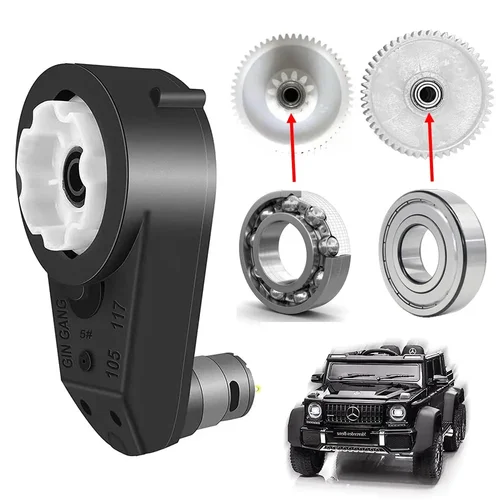
– Gears: Metal gears (brass, steel, or aluminum) last far longer than plastic ones. Plastic gears strip under high load or impact. If your application involves sudden stops or heavy loads, insist on metal gears.
– Bearings: Quality gearboxes use ball bearings on the output shaft, not plain bushings. Bearings reduce friction, improve efficiency, and extend lifespan.
– Housing: Die-cast aluminum or reinforced polymer housings resist deformation better than thin stamped steel or brittle plastic.
– Seals: Rubber or silicone seals prevent dust and moisture ingress—critical for outdoor or dirty environments.
Inspect product images for signs of sloppy assembly: misaligned gears, loose screws, or uneven welds. Read reviews mentioning longevity—units that last 6+ months under regular use are usually well-made.
6. Brand Reputation & Seller Reliability
With so many generic listings on Amazon, eBay, and AliExpress, brand matters more than ever. Established brands like Mabuchi (the original 550 motor maker), Johnson Electric, Buehler, and Pololu invest in quality control, consistent specs, and customer support. Generic “no-name” units may work initially but often fail prematurely due to inconsistent materials or poor tolerances.
Check the seller’s ratings and return policy. Avoid sellers with less than 95% positive feedback or those who don’t respond to pre-sale questions. Reputable vendors provide datasheets, dimension drawings, and compatibility guides.
If buying from overseas (e.g., China), allow extra time for shipping and be prepared for potential customs delays. Some regions restrict lithium battery shipments, which can delay motor orders if packed together.
7. Warranty & After-Sales Support
A warranty isn’t just a safety net—it’s a sign of confidence in the product. Most quality gearboxes come with a 6- to 12-month warranty against defects. Cheaper units often have no warranty or only 30 days.
Read the fine print: does the warranty cover wear and tear? What about user-induced damage (e.g., overvoltage)? Can you get a replacement or only a refund?
Good after-sales support includes responsive email/chat, troubleshooting guides, and replacement part availability. If a seller can’t tell you whether spare gears or brushes are available, consider it a red flag.
8. Noise Level & Vibration
While often overlooked, noise and vibration affect user experience—especially in indoor or quiet environments. High-pitched whining or excessive rattling indicates poor gear meshing, loose components, or unbalanced rotors.
Metal gears tend to be louder than plastic but more durable. Some premium units include dampening features like rubber mounts or helical gears to reduce noise.
If your project is noise-sensitive (e.g., a camera gimbal or medical device), look for “quiet operation” or “low-noise” in the description. User reviews often mention noise levels—pay attention to comments like “surprisingly quiet” or “sounds like a dentist drill.”
Different Types of Buying Guide

Common Buying Mistakes to Avoid
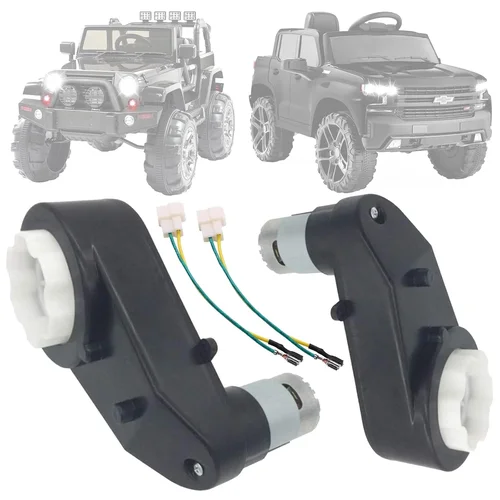
❌ Mistake: Assuming All “550” Motors Are Interchangeable
Why it’s bad: The “550” refers only to the motor can size—not the gearbox, shaft, or electrical characteristics. Two 550 motors can have completely different mounting holes, shaft diameters, or gear ratios, making them incompatible despite the shared label.
What to do instead: Always cross-reference your original motor’s part number, dimensions, and specs. When in doubt, contact the manufacturer or seller with your model details.
❌ Mistake: Ignoring Gear Material
Why it’s bad: Plastic gears wear out quickly under load, especially in high-cycle applications. They can strip teeth, melt from friction heat, or crack under impact—leaving your project dead in the water.
What to do instead: For anything beyond light play, choose metal-geared units. If budget is tight, look for hybrid designs (metal input gears, plastic output) as a compromise.
❌ Mistake: Overlooking Shaft Compatibility
Why it’s bad: A mismatched shaft means you can’t attach wheels, pulleys, or couplings. You’ll waste time and money on adapters or custom fabrication.
What to do instead: Measure your current shaft’s diameter, shape, and length. Confirm the replacement matches exactly—or plan for a compatible coupling upfront.
❌ Mistake: Buying Based Solely on Price
Why it’s bad: The cheapest option often uses substandard magnets, thin wires, and poor-quality brushes. It may work for a week—then fail catastrophically, potentially damaging your controller or battery.
What to do instead: Set a reasonable budget based on your application’s demands. For critical projects, invest in a reputable brand—even if it costs 2–3x more.
❌ Mistake: Not Checking Return Policies
Why it’s bad: If the motor doesn’t fit or perform as expected, you could be stuck with a useless component—especially with international sellers who charge high restocking fees or refuse returns.
What to do instead: Only buy from retailers with clear, buyer-friendly return windows (30+ days preferred). Avoid “final sale” items unless you’re 100% certain of compatibility.
❌ Mistake: Neglecting Thermal Management
Why it’s bad: Continuous operation without cooling causes overheating, which degrades brushes, demagnetizes the rotor, and warps gear housings.
What to do instead: Ensure adequate airflow around the motor. For enclosed spaces, consider adding a heatsink or fan. Monitor temperature during testing—if it’s too hot to touch after 5 minutes, it’s overheating.
❌ Mistake: Skipping the Datasheet
Why it’s bad: Product photos and titles often exaggerate capabilities. Without the datasheet, you don’t know true current draw, efficiency, or lifespan.
What to do instead: Demand a datasheet before purchasing. If the seller can’t provide one, assume the specs are unreliable.
Budget Guidelines: How Much Should You Spend?
– Entry-Level ($8 – $18): Suitable for一次性 prototypes, classroom demos, or non-critical toys. Expect plastic gears, basic bushings, and limited lifespan (weeks to months under regular use). Best for learning, not long-term reliability.
– Mid-Range ($20 – $40): The sweet spot for most hobbyists and DIYers. These units feature metal gears, ball bearings, and decent torque. Brands like Buehler, ServoCity, and generic-but-reliable Chinese manufacturers offer solid performance here. Ideal for RC vehicles, small robots, and home automation.
– Premium ($45 – $80): For professionals and serious builders. Expect precision-machined components, sealed bearings, robust housings, and detailed datasheets. These motors handle heavy loads, continuous operation, and harsh environments. Worth the investment for commercial prototypes or mission-critical systems.
– Luxury ($80+): Includes planetary gearboxes, custom windings, encoder feedback, and IP-rated enclosures. Reserved for high-precision applications like medical devices, aerospace prototypes, or industrial automation. Overkill for most personal projects—but unbeatable when performance is non-negotiable.
Expert Tips for Getting the Best Deal
– Shop during off-seasons: RC and robotics suppliers often discount older models in late winter (February–March) to clear inventory for spring releases.
– Use price-tracking tools: Set alerts on CamelCamelCamel (for Amazon) or Honey to catch drops below average price.
– Buy refurbished from OEMs: Some manufacturers sell factory-refurbished gearboxes at 30–50% off. These come with full warranties and are often indistinguishable from new.
– Check local electronics recyclers: Schools, universities, and repair shops sometimes sell salvaged motors cheaply. Great for testing or spare parts.
– Bundle with controllers: Purchasing a motor + ESC (Electronic Speed Controller) together often saves 10–15% versus buying separately.
– Read the return policy carefully: Some sellers charge 15–20% restocking fees. Others require you to pay return shipping—which can cost nearly as much as the motor itself.
– Test before final assembly: Power the motor briefly on a bench to verify direction, noise, and smooth operation. Catch issues early.
– Join hobbyist forums: Communities like Reddit’s r/robotics or RCGroups often have group buys or member discounts you won’t find elsewhere.

Frequently Asked Questions
Q: Can I use a 24V motor on a 12V system?
A: Technically yes, but it will run at half speed and produce significantly less torque. It’s inefficient and not recommended. Stick to 12V-rated motors for 12V systems.
Q: How do I reverse the motor direction?
A: Simply swap the positive and negative wires. Most DC motors reverse instantly when polarity is flipped.
Q: Will a higher gear ratio make my robot faster?
A: No—it will make it slower but stronger. Higher ratios increase torque at the expense of speed. Choose based on your load, not desired velocity.
Q: Are brushless motors better than brushed 550 motors?
A: Brushless motors offer higher efficiency, longer life, and less noise—but they require complex controllers and are much more expensive. For most 12V applications, a quality brushed 550 is simpler and more cost-effective.
Q: Can I run the motor continuously for hours?
A: Only if it’s rated for continuous duty and properly cooled. Check the datasheet for duty cycle specs. Intermittent use (e.g., 10 minutes on, 5 off) is safer for unknown units.
Q: What’s the difference between a spur gearbox and a planetary gearbox?
A: Spur gearboxes use simple parallel gears—cheaper and easier to maintain. Planetary gearboxes use multiple gears rotating around a central sun gear—more compact, efficient, and precise, but costlier.
Q: How do I know if my motor is burned out?
A: Signs include: no rotation when powered, excessive smoke or smell, grinding noises, or visible damage to brushes. Test with a multimeter—infinite resistance means an open circuit (dead).
Q: Can I repair a stripped gear?
A: Sometimes. If only one plastic gear is damaged, you may find replacement gears online. Metal gears usually require full replacement. Always replace both meshing gears to prevent uneven wear.
Q: Is it safe to run the motor without a load?
A: Yes, briefly. But prolonged no-load operation can cause overspeed, which wears brushes faster. It’s fine for testing—just don’t leave it running unattended.
Q: Do I need a fuse or circuit breaker?
A: Absolutely. A 20A fast-blow fuse protects against short circuits and stall conditions. Never wire a motor directly to a battery without protection.
Our Final Recommendations
– Best for Budget-Conscious Buyers: Generic Metal-Gear 12V 550 (10:1 ratio) – Around $22 on Amazon. Reliable for light-to-medium use, widely available, and easy to replace. Just verify shaft dimensions before ordering.
– Best Overall Value: Buehler 12V 550 High-Torque Gearmotor – Priced at $38, it offers brass-metal hybrid gears, sealed bearings, and a 12-month warranty. Perfect for RC cars and small robots.
– Best Premium Option: Pololu 12V 550 Planetary Gearmotor (50:1) – At $75, it delivers exceptional precision, low backlash, and quiet operation. Ideal for advanced robotics and automation.
– Best for Beginners: Mabuchi RS-550VC-12300 – The original 550 motor, now widely cloned but still available genuine from specialty suppliers (~$30). Simple, robust, and well-documented.
– Best for Advanced Users: Johnson Electric 12V 550 with Encoder Output – Includes built-in quadrature encoder for speed and position feedback. Essential for closed-loop control systems (~$95).
Conclusion: Making the Right Choice
Choosing the right replacement 12V 550 motor gearbox isn’t just about finding the cheapest or fastest option—it’s about matching the right tool to your specific need. Whether you’re keeping a childhood RC car alive or building the next great robotics project, the decisions you make now will determine how smoothly (and how long) your creation runs.
We’ve covered everything from physical compatibility and torque requirements to brand trust and budget planning. Remember: measure twice, buy once. Verify your current motor’s specs, prioritize metal gears for durability, and never skip the datasheet. And if you’re unsure, start with a mid-range unit from a reputable seller—it’s the best balance of cost, performance, and peace of mind.
Your project deserves a motor that won’t let you down. Take the time to choose wisely, and you’ll enjoy reliable performance for years to come. Now go grab that replacement—and get building!