
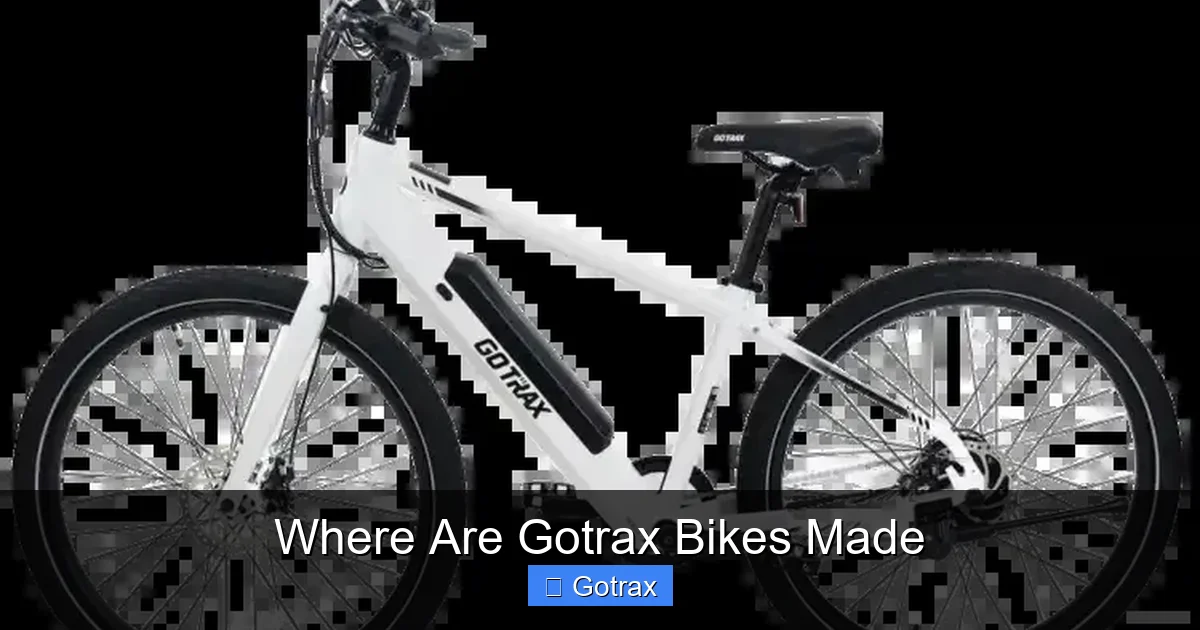
Gotrax bikes are primarily manufactured in China, with key production facilities in Shenzhen and Guangzhou. The company partners with experienced OEMs to ensure quality, affordability, and scalability across its electric bike and scooter lineup.
Key Takeaways
- Manufacturing Location: Gotrax bikes are made in China, specifically in industrial hubs like Shenzhen and Guangzhou, known for advanced electronics and e-mobility production.
- OEM Partnerships: Gotrax works with established original equipment manufacturers (OEMs) to design and assemble its electric bikes and scooters.
- Quality Control Standards: Despite overseas production, Gotrax implements rigorous quality checks and complies with U.S. and international safety certifications.
- Cost Efficiency: Manufacturing in China allows Gotrax to offer affordable e-bikes without sacrificing core performance features.
- Global Distribution: While made in China, Gotrax bikes are sold and shipped worldwide, with strong market presence in North America and Europe.
- Design & Innovation: Gotrax combines Chinese manufacturing expertise with U.S.-based design and customer support teams for a balanced product development approach.
- Environmental & Ethical Considerations: Gotrax emphasizes sustainable packaging and responsible sourcing, though full supply chain transparency remains limited.
[FEATURED_IMAGE_PLACEHOLDER]
Where Are Gotrax Bikes Made? A Deep Dive into Manufacturing Origins
If you’ve ever ridden a Gotrax electric bike or scooter, you might have wondered: where are Gotrax bikes made? It’s a fair question—especially in today’s world, where consumers care deeply about product origins, ethical manufacturing, and environmental impact. Gotrax has become a household name in the affordable electric mobility space, offering sleek, budget-friendly e-bikes and scooters that appeal to commuters, students, and casual riders alike. But behind that accessible price tag and modern design lies a global supply chain that starts thousands of miles away.
The short answer? Gotrax bikes are primarily manufactured in China. More specifically, production takes place in major industrial centers like Shenzhen and Guangzhou—cities renowned for their electronics manufacturing ecosystems and expertise in e-mobility components. These regions house vast networks of factories, suppliers, and logistics hubs that make large-scale, cost-effective production possible. Gotrax doesn’t own its own factories; instead, it partners with experienced original equipment manufacturers (OEMs) who specialize in building electric vehicles to spec. This model allows Gotrax to focus on design, branding, and customer experience while leveraging the efficiency of established manufacturing partners.
But knowing where something is made is only part of the story. What really matters is how it’s made—and whether that process aligns with your values as a consumer. In this article, we’ll explore not just the geographic origins of Gotrax bikes, but also the broader implications of their manufacturing strategy. We’ll look at the role of Chinese factories, the importance of quality control, how Gotrax balances affordability with performance, and what this means for riders in the U.S. and beyond. Whether you’re considering your first e-bike or just curious about the journey from factory floor to your driveway, this guide will give you the full picture.
The Manufacturing Heartland: Why China?
So why China? It’s a question that comes up with nearly every consumer electronics product today—from smartphones to smartwatches to electric scooters. And the answer lies in a combination of infrastructure, expertise, and economics. China has spent decades building itself into the world’s manufacturing powerhouse, particularly in the electronics and electric vehicle sectors. Cities like Shenzhen are often called the “Silicon Valley of Hardware” for a reason: they offer an unmatched concentration of component suppliers, assembly lines, engineering talent, and logistics networks—all within close proximity.
For a company like Gotrax, which aims to deliver high-value electric bikes at competitive prices, this ecosystem is essential. Electric bikes require a complex mix of parts: lithium-ion batteries, brushless motors, control boards, displays, brakes, frames, and more. Sourcing and assembling these components efficiently demands a well-oiled supply chain—something China excels at. Many of the world’s leading battery manufacturers, such as CATL and BYD, are based in China. Similarly, motor and controller suppliers have deep roots in the region. This means Gotrax can work with factories that already have the tools, experience, and supplier relationships to build reliable e-bikes quickly and at scale.
Another key factor is labor and operational cost. While wages in China have risen over the past decade, they still remain significantly lower than in the U.S. or Western Europe. This cost advantage allows Gotrax to keep retail prices low—often under $1,000 for many of its models—while still turning a profit. Of course, lower costs don’t automatically mean lower quality. The factories Gotrax partners with are typically ISO-certified and have experience producing for global brands. Many also manufacture for other well-known e-bike and scooter companies, which means they’re held to high standards by multiple clients.
It’s also worth noting that China has made major investments in green technology and sustainable manufacturing in recent years. While environmental regulations vary by region, many factories in Shenzhen and Guangzhou now use cleaner energy sources and implement waste reduction programs. Gotrax itself emphasizes eco-friendly packaging and promotes its products as alternatives to gas-powered vehicles, aligning with broader sustainability trends.
Gotrax’s Manufacturing Partners: The Role of OEMs
Gotrax doesn’t operate its own factories. Instead, it relies on a network of original equipment manufacturers (OEMs)—third-party companies that design and build products based on Gotrax’s specifications. This is a common model in the tech and e-mobility industries, allowing brands to scale rapidly without the massive capital investment required to own and manage production facilities.
These OEM partners are typically large, well-established factories with years of experience in electric vehicle production. They handle everything from prototyping and component sourcing to final assembly and testing. Gotrax provides the design blueprints, performance targets, and branding guidelines, while the OEM executes the build. This division of labor allows Gotrax to stay agile—launching new models quickly in response to market trends—while benefiting from the OEM’s manufacturing expertise.
One advantage of this model is consistency. Because Gotrax works with a limited number of trusted partners, it can maintain tighter control over quality and production timelines. These factories often produce multiple models for Gotrax, which helps streamline processes and reduce variability. For example, the same factory might assemble both the Gotrax GXL V2 electric scooter and the Gotrax G4 e-bike, using similar battery packs or motor systems. This kind of standardization improves reliability and simplifies repairs and part replacements down the line.
However, working with OEMs also means Gotrax has less direct oversight than if it owned its factories. To compensate, the company employs a combination of on-site quality audits, third-party inspections, and compliance checks. Many of these factories are also certified under international standards such as ISO 9001 (quality management) and ISO 14001 (environmental management), which adds another layer of accountability.
It’s also important to understand that OEMs in China often serve multiple brands. This isn’t necessarily a red flag—many reputable companies use the same factories. For instance, a single facility might produce scooters for Gotrax, Segway, and Razor, each with slight modifications to meet brand-specific requirements. The key is in the specifications: Gotrax defines its own performance metrics, safety features, and design elements, ensuring that its products stand apart even if they share a production line with competitors.
Quality Control and Safety Standards
One of the biggest concerns consumers have about products made in China is quality control. After all, not all factories are created equal—and a low price tag can sometimes signal corner-cutting. But Gotrax takes several steps to ensure its bikes meet high safety and performance standards, even when manufactured overseas.
First, Gotrax requires all its products to comply with U.S. and international safety regulations. In the United States, electric bikes must meet guidelines set by the Consumer Product Safety Commission (CPSC), including limits on motor power (typically 750 watts or less for Class 1 and 2 e-bikes), speed, and braking performance. Gotrax bikes are designed and tested to meet these requirements before they ever reach store shelves.
In addition to regulatory compliance, Gotrax implements its own internal quality control processes. This includes pre-production design reviews, in-process inspections during assembly, and final product testing before shipping. Many of these checks are conducted by third-party testing labs that specialize in electric vehicles. For example, Gotrax bikes are often tested for battery safety, waterproofing (IP ratings), and durability under real-world conditions like hills, rain, and rough pavement.
Battery safety is a particular focus. Lithium-ion batteries can pose fire risks if poorly manufactured or damaged, so Gotrax uses only certified battery cells from reputable suppliers. Each battery pack undergoes rigorous testing for overcharge protection, thermal stability, and cycle life. The company also includes safety features like battery management systems (BMS) that monitor voltage, temperature, and current to prevent failures.
Another layer of quality assurance comes from customer feedback. Gotrax has a strong presence on online marketplaces like Amazon, where users leave detailed reviews about performance, build quality, and longevity. The company monitors this feedback closely and uses it to make improvements in future models. For instance, if multiple users report issues with a specific brake model or display screen, Gotrax can work with its OEM to address the problem in the next production run.
It’s also worth noting that Gotrax offers warranties on its products—typically one year for e-bikes and scooters—which reflects confidence in their durability. While no product is perfect, the fact that Gotrax stands behind its bikes with repair or replacement support suggests a commitment to quality beyond just meeting minimum standards.
From Factory to Front Door: The Global Supply Chain
Once a Gotrax bike rolls off the assembly line in China, it begins a journey that can span thousands of miles before it reaches your hands. Understanding this supply chain helps explain not just where the bikes are made, but how they get to market so affordably and efficiently.
After final inspection, the bikes are packed into shipping containers—usually in knockdown (CKD) form, meaning they’re partially disassembled to save space. This reduces shipping volume and costs, which is a major factor in keeping retail prices low. The containers are then loaded onto cargo ships bound for major ports in the United States, such as Los Angeles, Long Beach, or New York.
From there, the bikes are transported by truck to regional distribution centers. Gotrax works with logistics partners like Amazon, FedEx, and regional warehousing networks to manage inventory and fulfill orders. Many Gotrax bikes are sold directly through online platforms, which allows for faster delivery and lower overhead compared to traditional retail stores.
One advantage of this model is speed to market. Because the bikes are produced in large batches and shipped in bulk, Gotrax can maintain steady inventory levels and respond quickly to demand spikes—like during holiday seasons or when a new model launches. It also allows for competitive pricing, as the company benefits from economies of scale.
However, global shipping isn’t without its challenges. Delays due to port congestion, customs inspections, or geopolitical issues can impact delivery times. Environmental concerns are also a factor—shipping goods across the ocean contributes to carbon emissions. Gotrax has taken some steps to mitigate this, such as using recyclable packaging materials and optimizing container loads to reduce waste. Still, the carbon footprint of international shipping remains a consideration for eco-conscious buyers.
On the plus side, the efficiency of this supply chain means Gotrax can offer frequent discounts, bundle deals, and fast shipping options—often with free delivery within the continental U.S. This accessibility has helped the brand build a loyal customer base, particularly among budget-minded riders who want reliable e-mobility without the premium price tag.
Design, Innovation, and the U.S. Connection
While the bikes are made in China, much of Gotrax’s design and innovation work happens in the United States. The company is headquartered in New Jersey and maintains a team of engineers, designers, and customer support specialists who focus on product development, user experience, and after-sales service.
This hybrid model—design in the U.S., manufacturing in China—is common among modern consumer brands. It allows Gotrax to stay close to its core market (North America) while benefiting from global manufacturing capabilities. The U.S. team handles everything from initial concept sketches to user interface design, safety testing, and marketing strategy. They also gather feedback from American riders to inform future models.
For example, the Gotrax G4 e-bike was designed with urban commuters in mind—featuring a step-through frame for easy mounting, integrated lights for safety, and a rear rack for carrying bags. These features reflect input from U.S. customers who prioritize convenience and practicality. The design team then works with the OEM in China to translate these ideas into a manufacturable product, balancing innovation with cost and feasibility.
Gotrax also invests in software and connectivity. Many of its newer models include Bluetooth-enabled apps that let riders track speed, battery life, and distance. These digital features are developed by U.S.-based tech teams and integrated into the hardware during production. This blend of hardware and software innovation helps Gotrax compete with more expensive brands that offer similar smart features.
Customer support is another area where the U.S. presence shines. Gotrax offers phone, email, and live chat support during business hours, with representatives based in the U.S. This makes it easier for customers to get help with setup, troubleshooting, or warranty claims—something that can be a challenge with overseas-only brands.
Affordability vs. Quality: Striking the Balance
One of the most common questions about Gotrax bikes is whether their low prices mean lower quality. The truth is more nuanced. Gotrax manages to keep costs down through smart design choices, efficient manufacturing, and economies of scale—not by cutting corners on safety or core performance.
For example, Gotrax bikes use proven, reliable components rather than cutting-edge (and expensive) technology. The motors are typically 250W to 500W, which is sufficient for city riding but not designed for high-speed off-road use. The frames are made from lightweight aluminum, which is durable and rust-resistant without the premium cost of carbon fiber. These choices keep the bikes affordable while still delivering a solid riding experience for most users.
That said, there are trade-offs. Some users report that lower-end models may have less refined suspension or slightly noisier motors compared to premium brands. Replacement parts can also be harder to find locally, though Gotrax does offer service kits and online support. But for the price—often half the cost of similar e-bikes from brands like Rad Power or Aventon—many riders find the value proposition compelling.
Gotrax also focuses on simplicity. Its bikes are designed to be easy to assemble, ride, and maintain, which reduces the need for specialized tools or expertise. This user-friendly approach appeals to casual riders who don’t want to deal with complex setups or frequent tune-ups.
Ultimately, Gotrax bikes are best suited for flat urban environments, short commutes, and recreational use. If you’re looking for a high-performance mountain e-bike or a long-range touring model, you may need to look elsewhere. But for everyday mobility, Gotrax offers a reliable, affordable option that gets the job done.
Environmental and Ethical Considerations
As consumers become more conscious of sustainability and ethics, it’s important to consider the broader impact of where and how products are made. Gotrax has made some efforts in this area, though transparency remains limited.
On the environmental side, Gotrax promotes its bikes as eco-friendly alternatives to cars and gas-powered scooters. By encouraging electric mobility, the company contributes to reduced emissions and lower urban congestion. The bikes themselves are powered by rechargeable lithium batteries, which have a lower carbon footprint over their lifetime compared to internal combustion engines.
Gotrax also uses recyclable packaging materials and avoids excessive plastic in its shipping boxes. Some models even come with reusable tote bags or tool kits, reducing waste. However, the company does not publish detailed sustainability reports or carbon footprint data, so it’s hard to assess the full environmental impact of its operations.
Ethically, the situation is more complex. While Gotrax’s OEM partners are expected to follow labor laws and safety standards, the company does not publicly disclose factory audits or worker conditions. This is a common challenge in global supply chains, where oversight can be difficult. That said, many of the factories Gotrax works with are certified under international labor and environmental standards, which suggests a baseline level of compliance.
For buyers who prioritize ethical manufacturing, it may be worth reaching out to Gotrax directly to ask about their supplier code of conduct or sustainability initiatives. As consumer demand grows, more companies are being pushed to improve transparency—and Gotrax may follow suit in the future.
Conclusion: Made in China, Built for the World
So, where are Gotrax bikes made? The answer is clear: they’re manufactured in China, primarily in the industrial hubs of Shenzhen and Guangzhou, through partnerships with experienced OEMs. This global manufacturing strategy allows Gotrax to deliver affordable, reliable electric bikes and scooters to customers around the world—especially in the U.S., where demand for budget-friendly e-mobility is growing.
While the overseas production model raises valid questions about quality, ethics, and environmental impact, Gotrax takes steps to address these concerns through rigorous testing, compliance with safety standards, and a focus on customer satisfaction. The company’s hybrid approach—combining U.S.-based design and support with Chinese manufacturing efficiency—enables it to offer great value without sacrificing core performance.
Ultimately, Gotrax bikes are a testament to the power of global collaboration in modern manufacturing. They may not be handmade in a local workshop, but they’re built with care, tested for safety, and designed with real riders in mind. Whether you’re commuting to work, running errands, or just enjoying a weekend ride, a Gotrax bike offers a practical, eco-friendly way to get around—all thanks to a supply chain that spans continents but delivers results right at your doorstep.
Are Gotrax bikes made in the USA?
No, Gotrax bikes are not made in the USA. They are manufactured in China, primarily in factories located in Shenzhen and Guangzhou. However, the company is headquartered in New Jersey and handles design, marketing, and customer support from the U.S.
Who makes Gotrax electric bikes?
Gotrax partners with original equipment manufacturers (OEMs) in China to produce its electric bikes and scooters. These factories specialize in e-mobility products and build Gotrax bikes to the company’s specifications.
Are Gotrax bikes good quality?
Yes, Gotrax bikes are generally well-regarded for their affordability and reliability. They undergo quality control testing and meet U.S. safety standards, though they may not match the premium feel of higher-end brands.
Where are Gotrax bikes shipped from?
Gotrax bikes are shipped from distribution centers in the United States, often fulfilled through partners like Amazon. The bikes are manufactured in China and imported in bulk before being distributed domestically.
Can I get replacement parts for my Gotrax bike?
Yes, Gotrax offers replacement parts and service kits through its website and customer support team. Availability may vary by model, but common components like batteries, tires, and chargers are typically in stock.
Is Gotrax environmentally friendly?
Gotrax promotes its bikes as eco-friendly alternatives to gas-powered vehicles and uses recyclable packaging. However, the company does not publish detailed sustainability reports, so the full environmental impact is not publicly available.
This is a comprehensive guide about where are gotrax bikes made.
Key Takeaways
- Understanding where are gotrax bikes made: Provides essential knowledge
Frequently Asked Questions
What is where are gotrax bikes made?
where are gotrax bikes made is an important topic with many practical applications.